
Introduction
Welcome to our Annual Performance Report. This report is designed to provide a high-level overview of our performance for 2025/26.
We set a number of key performance metrics which help to inform us if we are meeting our key objective to keep people safe in their homes, and in our communities. Delivered through our core response, prevention and protection work. For the majority we set a target and meeting this target gives assurance that we are delivering our objectives.
I am pleased to report that we have met the majority of our performance metrics with 59% meeting target and 22% close to target. I am also pleased that when surveyed 93% of people informed us that they were very satisfied with the service we provide in emergency response.
We publish a Community Risk Management Plan that sets the strategic direction for the Service, setting out what we will do to ensure we deliver a high-quality, best value fire and rescue service through our strategic objectives of response, prevention, protection, resilience, resources, and people.
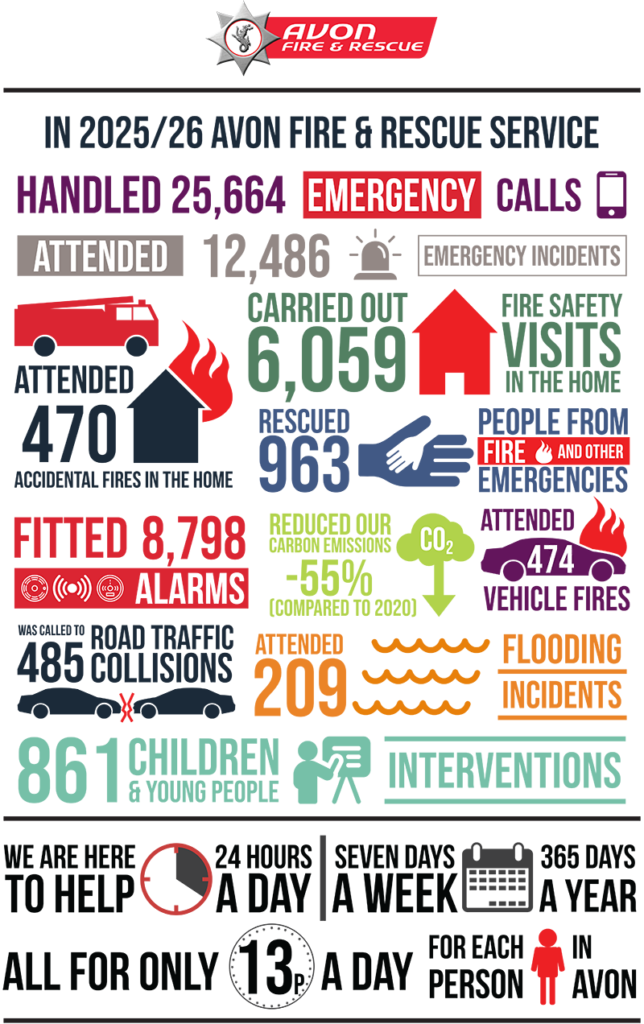
We also produce a poster that is displayed on our fire stations and other media and gives a summary of the great work we have achieved. The poster is included in this report below. I hope that you will find our performance report useful in keeping you informed about the service we provide.
As Chief Fire Officer, my priorities are centred around service:
- Serving You, Empowering Us: I’m committed to ensuring that our service has the leadership that creates a supportive culture enabling us to thrive as one team. This means ensuring we can carry out our crucial work together safely and effectively, within an inclusive and positive environment that prioritises wellbeing.
- Serving Our Communities, Building Trust: We are here for every member of our community, and to help each other in that single endeavour. I’m dedicated to strengthening our relationships, fostering trust, and working collaboratively to make our four unitary authorities an even safer place for all.
- Embracing Continuous Improvement: Together, we will build on the strong foundations of Avon Fire & Rescue Service by embracing new ideas and always striving to improve in everything we do.
We remain committed to improving Avon Fire and Rescue Service to ensure that we continue to deliver an efficient and effective service for the communities that we serve.
Matt Cook
Chief Fire Officer/Chief Executive
Performance metrics
We have a number of key performance metrics that measure our performance against. If we meet targets for these metrics, we can be confident that we are meeting our objectives of creating a Safer Community and a Stronger Service.
Our performance metrics are grouped together under our six Core Commitments:
- Prevention
- Protection
- Response
- Resilience
- Resources
- People
Overall performance has been good with 19 of our 32 (59%) scorecard metrics meeting target and showing green, a further seven (22%) just off target and showing amber and only six (19%) off target and showing red.
Prevention
Fires
We have met target for two of our four fire metrics (Accidental dwelling fires and Deliberate fires in vehicles) and are just off target for Deliberate secondary fires. We finished the year off target for Deliberate primary fires, mainly due to spikes in incident numbers during the exceptionally dry and hot summer months. In the last five months incident number are fewer than last year and under target:
Deliberate Fires (excluding vehicle fires) data
Target: 199
Actual: 314
| Month | Number of incidents |
|---|---|
| April | 33 |
| May | 47 |
| June | 24 |
| July | 44 |
| August | 56 |
| September | 19 |
| October | 25 |
| November | 16 |
| December | 10 |
| January | 12 |
| Febraury | 11 |
| March | 17 |
We have a Seasonal “Heat-Ready” trigger plan ready to put in place in case of similar weather patterns in 2026/27.
Data released by the Ministry of Housing, Communities and Local Government (MHCLG) for the 12 months to December 2025 confirm that there has been a national increase in recorded fire incidents “FRSs attended 642,264 incidents in the year ending December 2025, an increase of 6.8% compared with the previous year (601,335)”. Full release: Fire and rescue incident statistics, year ending December 2025 – GOV.UK
Fire deaths and injuries
We do not set targets for fire deaths and injuries as the numbers are too small to measure significance. In 2025/26 we recorded five deaths due to fire and 50 injuries. Each fire death is investigated to identify the full circumstances and whether there is any learning we can apply to our interventions.
Education packages delivery
We finished the year just off target for completing key stage education packages delivered with 861 delivered against a target of 900. We target our interventions to ensure that an appropriate message is delivered to those young people most at risk.
Home Fire Safety Visits
We were off target for completing Home Fire Safety Visits (HFSV) with 6066 delivered against a target of 7000.
We also just missed our target for completing HFSVs within our agreed timeframe.
For 2026/27 we have increased the resources in our Vulnerable Adults team and will be improving our processes for generating HFSV referrals from partner agencies. We will also improve our administrative processes to ensure that HFSVs are scheduled within an achievable timeframe.
We are pleased to report that 93% of the HFSVs completed were to the most vulnerable members of our community (as defined by the MHCLG). The latest benchmarking data (2024/25) shows we compare favourably for targeting our HFSVs (17 out of 44).
Protection
Building Regulation and Licencing Applications
We are pleased to report that our Protection team have met target for responding to Building Regulation and Licencing Applications with each achieving 99% processed within target.
Fire Safety Audits
We also met target for our Business Fire Safety team to complete. These checks are designed to ensure that non-domestic premises are complying with fire safety legislation.
Attendance at automatic fire alarms in non-domestic properties
We were just off target for reducing alarms caused by automatic fire detection attended (Non-Domestic Properties). Our Control team work hard to ensure that we only attend alarm activations where there the risk information justifies our attendance.
We do not set a target for alarm attendance at domestic properties as we have no enforcing powers.
Site Specific Risk Re-inspections
Site Specific Risk Re-inspections (SSRIs) are where our fire crews visit premises that are identified as high risk. The visit allows us to identify the risks that are present and to mitigate these risks. We have systems that share this risk information with any fire crew attending an incident at the premises.
We missed target for completion SSRIs within target. During 2025/26 we agreed to reset our targets to ensure that they are more aligned to the identified risk. For 2026/27 this will mean that the target dates are more realistic. Completion information is available on our Internal dashboards which help us to track performance down to individual stations and watches.
Operational fire safety checks
We met our target for completing Operational fire safety checks (OPsFsCs) with 1,384 completed against a target of 1,332.
Response
Response standards
We are pleased to report that, despite the number of incidents we attend increasing by 1% (12,489 compared to 12,418), we have met targets for all of our Response metrics.
We categorise our response standards dependent upon whether at time of call it was considered that there was an indication of a threat to life or not.
For incidents where it was considered there was a threat to life, we have a target of an average response time target of eight minutes, and we met target with an average of 07:42 seconds.
For incidents where it was considered there was no immediate threat to life, we have a target of an average response time target of 12 minutes and met target with an average of 08:01 seconds.
We validate our response standards by asking a sample of people who we have assisted in an emergency if they were satisfied with the speed of our response. We are pleased to report that in 2025/26, 96% of respondents felt that the speed of our response was quicker than or as they expected.
999 call handling
We are pleased to report that our Control team met our target to answer 94% of 999 calls within seven seconds. We answered 95.7% within seven seconds (15,784 out of 16,496 calls).
Mobilising system
We measure the effectiveness of the Service Level Agreement (SLA) we have with the supplier of our Control system. We are pleased to report that the target was met with 100% of incidents being dealt with in line with the SLA.
Resilience
Sickness absence
We have missed target for Working days/shifts lost to sickness (excl. On-Call) with 11.53 days/shifts per Full Time Equivalent (FTE) lost against a target of 9.52. During 2026/27 we plan to update our processes for managers reporting sickness directly into our system, and improved quality assurance of our sickness reporting by our new Wellbeing and Fitness team.
Utilising our Supporting Attendance Policy and encouraging staff to engage with the supporting attendance toolkit, we will also continue to improve on our communication with managers and staff regarding their responsibilities to report and manage sickness timely and effectively.
Resources
Health and Safety metrics
We missed our target for ensuring that at least 50% of our recorded Health and Safety (H&S) incidents were near miss incidents. This was mainly due to resourcing in our H&S team which has been addressed by the approval of a business case for additional resources within the team Performance improved towards the end of the year however and we are confident that we will meet target in 2026/2027.
We recognise that it is important that H&S incidents investigated and closed timely. Our target to ensure that 80% are closed within 28 days and at the end of the year 90% of investigations met this target.
We also monitor the number of Reporting of Injuries, Diseases and Dangerous Occurrences Regulations (RIDDOR) that we have. In 2025/26 we reported five. We do not set a target as the numbers are too small to be significant.
Reducing Carbon Emissions
We finished the year just off target for reducing our Carbon Emissions, part of our journey to become Carbon neutral by 2030, reporting a 55% reduction against a 58% target. Our target is non-linear as we recognise that the initiatives we need to de-carbonise will become available to us at different stages through the 10 years. Our environmental team have highlighted the following that has impacted upon our performance:
This year we purchased specific gases (used by Fleet for vehicle air conditioning) for the first time in four years. These gases have high carbon emission conversion factors adding 16 tonnes of Co2 emissions to this year’s total. For context, without this purchase emissions would be 649 tonnes (56%) compared to 656 tonnes for 2024/25.
There has also been a drop of over 4,600 litres of fuel used by Fleet this year, reducing petrol and diesel emissions by three tonnes. Although this is a positive trend, an increase in the official conversion factors used for calculating diesel emissions has added approximately 14 tonnes, compared to last year’s conversion factors. This is likely to continue increasing year on year due to the environmental impact of this fuel type and countering any emissions savings made from reduced diesel consumption.
Budgets
We set targets to ensure that both our Budget variance against forecast and Revenue Budget variance against planned are managed effectively, staying within a target band of no more than 1% and no less than 2.5%. We are pleased to report that both these targets were met with 0% variance on each.
Freedom of Information
We recognise the importance of providing excellent service by responding to Freedom of Information (FOI) requests within target. The requests we receive range from people who have experienced an emergency incident and require details to make a claim against their insurance to more detailed information about our service and services.
Our target is to respond to 85% of FOI requests within a 20 day target and in 2025/26 we achieved 98.2%.
Procurement contracts
It is important that we manage our procurement contracts effectively, ensuring that they are reviewed and renewed in accordance with legislation and to ensure that the vital provision of the services and equipment we need is not disrupted. We set a target that at least 85% are in date and at the end of 2025/26 we met this target with 98% in date.
Collaboration and Partnerships
We recognise the importance of collaboration and partnership working and, for this to be effective, managing our agreements effectively. Each partnership or collaboration is reviewed on an annual basis to ensure that it is meeting its objective and functioning as expected. Our target is to ensure that 85% are reviewed within target and at the end of 2025/26 we met target with 100% in date.
Policies
Maintaining our policies within review date also deteriorated at the end of year and we missed target. Our Business Services team ensure that we have good information as to when Policies require review. The main issue remains capacity within our People Services team who are owners of 30% of our policies. The Head of People Services is working on developing policy writing skills within the team to improve capacity and capability.
Information and Communication Technology
We have also met our targets for our Information and Communication Technology metrics. On a monthly basis we measure the availability of our core systems and if March 2026 this was 100%. We also report the customer feedback for issues raised with our ICT team and this finished the year on 95%.
His Majesty’s Inspectorate of Constabulary and Fire & Rescue Services recommendations and Areas for improvement
We have a number of recommendations and areas for improvement that were identified by His Majesty’s Inspectorate of Constabulary and Fire & Rescue Services (HMICFRS). For each of these we set a date for when we will complete the actions necessary to discharge the issue and we measure our progress to make sure we are on track. Our target is to be on track for 90% and at the end of 2025/26 we were just off target with 87%. Further information about HMICFRS is provided below.
Further information about HMICFRS is provided below.
People
Fitness tests for operational staff
We set a target for 95% of our operational staff to have an in-date fitness test. At the end of 2025/26 were just off target with 90.43% in date. Our Wellbeing and Fitness team have recruited a new Fitness Advisor who will make sure we meet this target next year.
Personal Development Reviews
We set ourselves a challenging target to ensure that Personal Development Reviews (PDRs) are in date for 95% of our staff and are pleased to report that this was achieved with 97.8% in date at the end of the year.
Compliments and Complaints
Compliments
In 2025/26 we received 69 written compliments about the services we provide. Some highlights include:
Thank you for your heroic work you do to keep our place safe. You all done an excellent job and I have no idea how you managed to do that but nothing else pure professionalism. Thank you and really appreciate your work done to keep us and our neighbours safe.
Complaints
We also received 39 complaints about the service we provide. For three of these not enough evidence or information was provided to allow us to investigate and for a further one was found not to be about our service.
The subjects of the remaining 35 complaints were:
| Complaint subject | Number of complaints |
|---|---|
| Cultural issues | 10 |
| Operational response | 6 |
| Community engagement | 4 |
| Driving | 3 |
| Control team | 2 |
| Insurance claims | 2 |
| Business fire safety team | 2 |
| Inappropriate use of water | 2 |
| Management of our premises | 2 |
| Payment to contractor | 1 |
| Our website | 1 |
For eight of the complaints our investigation found that we were at fault. We received a further three complaints about behaviour of our staff; however, upon investigation, for all three we were not found to have been at fault.
For eight of the complaints our investigation found that we were at fault.
We received a further three complaints about behaviour of our staff; however, upon investigation, for all three we were not found to have been at fault.
Progress against our Service Plan
Over the past year, we have delivered an ambitious and wide‑ranging programme of improvements across our Service, enhancing operational processes, strengthening our digital capability, and improving staff experience – all with a clear focus on improving community and fire safety. The following highlights some of the key achievements that demonstrate how we have delivered against our CRMP objectives, reflecting strong collaboration and a shared commitment to building a modern, inclusive organisation.
Review our Unwanted Fire Signals policy and monitor data to ensure we are responding in the most efficient and effective way.
The Unwanted Fire Signals review delivered key improvements through a revised Standard Operating Procedure (SOP) and 14 targeted actions. Enhanced data monitoring, updated guidance, media campaigns, and stronger stakeholder engagement have been implemented. While reductions are still emerging, robust performance frameworks and interventions are now in place to improve resource availability and reduce unnecessary mobilisation costs.
Regularly exercise our operational capability with partner agencies in our Service area and cross-border. Ensuring operational staff have good access to relevant and up-to-date cross-border risk information.
The Service strengthened cross-border preparedness by implementing arrangements to capture and share Site-Specific Risk Information with neighbouring fire and rescue services. High and very high-risk sites are now accessible to crews via Resilience Direct and mobile devices. This has improved interoperability, supported multi-agency planning through Local Resilience Forums, and enabled more effective joint training and exercising at cross-border risk sites.
Include prevention and protection teams in operational incident debriefs to ensure learnings are captured, improvements are made, and information feeds back into our CRMP process.
The Service has strengthened organisational learning by introducing a structured approach to capturing, managing and governing learning from operational incidents. A new Operational Learning app and formal debrief processes ensure consistent recording and review through Operational Learning and Feedback (OLAF) governance. Insights are shared across prevention and protection functions, translated into action, and embedded through training, procedures and risk management, supporting continuous improvement and CRMP development.
Improve our digital capability by focusing on our six core IT strategic themes to ensure our ICT systems are resilient and reliable. The Service has strengthened its digital capability through delivery of core ICT strategic themes, improving resilience, reliability and performance across systems. Key achievements include modernisation of network infrastructure, cloud migration and application consolidation, alongside enhanced cyber security maturity. ICT restructuring, data strategy development and financial efficiencies have further improved operational effectiveness. User experience has also been strengthened through service improvements, enterprise tools, and deployment of mobile data technology.
Demonstrate our commitment to our staff and communities by ensuring our culture and core values align with the NFCC Core Code of Ethics.
The Fire Authority approved the People, Culture and Leadership Strategy (2025–2030), providing clear direction for fostering inclusive leadership, respect, and open dialogue across the Service. Early progress is already evident through improved feedback mechanisms and co-created change initiatives. In parallel, a new People Dashboard has enhanced access to performance data, supporting managers in day-to-day decision-making and enabling insight-driven cultural development.
Educate our communities with a focus on those at higher risk by reducing harm and enhancing safety and wellbeing. The Service has continued to strengthen community education and harm reduction through a coordinated approach to water safety, working closely with partners including the RNLI. A new partner-facing dashboard provides visibility of water-related incidents and water safety cabinet locations, improving shared understanding and targeted prevention. This is complemented by long-standing joint education programmes in schools and communities, Be Water Aware Week engagement reaching around 2,000 visitors at Bath Fire Station, and over 100 youth interventions delivered in the last 15 months, all contributing to safer, more resilient communities.
His Majesty’s Inspectorate of Constabulary and Fire & Rescue Services
Following the His Majesty’s Inspectorate of Constabulary and Fire & Rescue Services (HMICFRS) Round 3 Inspection the service was issued two accelerated causes of concern (Mobilising system and Risk Information) and two further causes of concern (Prevention and Values & Culture). The Inspectorate also identified 31 areas for improvement. The mobilising system accelerated cause of concern was closed in October 2024.
HMICFRS revisited the service in July 2025 to review progress against the Risk Information accelerated and Prevention causes of concern.
HMICFRS determined that the service had made good progress in:
- identifying all those premises that require a site-specific visit
- uploading risk information in a timely manner
- Fire Control having access to relevant and up-to-date risk information, including evacuation strategies, in high-rise residential buildings
- quality assurance of its prevention activity so staff carry out HFSVs to an appropriate standard
- ensuring staff carry out Home Fire Safety Visits and wider prevention activities competently
The recommendations for the above were closed, along with the Risk Information accelerated cause of concern.
The service has also worked throughout 2025/26 to deliver improvements against the areas for improvement and strengthened internal governance processes. An Internal Improvement Steering Group has been introduced to support the work of the Internal Improvement Board. The improvement work carried out in eight areas for improvement have been signed off by the Internal Improvement during 2025/26.
A full inspection of the service by HMICFRS took place between 17 November 2025 and 13 February 2026. The outcome of that inspection will be published around the end of June 2026 and will be available on the HMICFRS website.
Progress against Key Projects
Overall delivery across the portfolio has continued to progress positively, with a marked strengthening of governance, improved visibility of project health, and a shift from stabilisation into active delivery on several priority initiatives. Since October 2025, the number of projects rated Green has increased and, by April 2026, no projects are reported as Red, reflecting the impact of clearer sponsorship, improved controls, and more consistent portfolio oversight.
An Efficiencies and Savings programme has achieved its target of £505k in financial savings for the previous financial year.
FireWatch Utilisation has progressed from a period of governance reset into structured delivery, supported by dedicated PMO resource. Early phases have progressed well, particularly around system upgrade, notifications and wider system utilisation. Governance, documentation and management of interdependencies, particularly with Vision and mobilising systems, are significantly stronger with a robust plan in place.
The Severn Park programme has moved beyond initial scoping into a more structured planning and governance phase. The Steering Group is actively reviewing draft plans, proposed working groups and early delivery structures. Risk trends and proximity are reviewed routinely providing a stronger foundation for longer‑term decision making ahead of the PFI expiry in 2028.
The Bath Redevelopment project has achieved several significant milestones, including securing planning approval and progressing through pre‑construction activity. By April 2026, the project focus is firmly on final contract confirmation, mobilisation and site activity.
The Mobilising System Upgrade has progressed steadily, with contracts signed and implementation activity underway. Key documents have been reviewed, governance arrangements updated, and active risk management is in place to address future resourcing pressures and dependencies with other major projects.
Alongside delivery activity, significant progress has been made in strengthening the Service’s project governance foundations. The new Project Management Framework was approved by SLT in January 2026 and implementation is now underway. Early benefits are already visible, including clearer commissioning routes, more consistent reporting, improved accountability and greater transparency of demand across the portfolio.
Improvements to the Impact Assessment process are also reaching completion, with a revised review and archiving approach launched. This directly addresses an HMICFRS Area for Improvement and introduces a more proportionate, sustainable approach while retaining a full audit trail.
A new Business Case Forward Plan is now in place, providing better transparency and supporting prioritisation discussions, but sustained pressure on capacity continues to reinforce the importance of disciplined governance and sequencing.
The portfolio is more stable, more transparent and better governed than in previous reporting periods.
Emerging Risk
We face an evolving risk landscape over the next financial year, driven by a changing environment and shifting societal needs.
The most significant emerging risk is the ongoing impact of climate change. The increasing frequency and severity of extreme weather events increases the likelihood of incidents such as fires, road traffic collisions and other calls for rescue. 2025 was the warmest and sunniest year on record in the UK. Prolonged periods of low rainfall and higher than average temperatures resulted in a record number of wildfires across the UK. Sustained high temperatures also pose a higher risk for people with health conditions, especially if temperatures remain high t overnight, and there are also risks associated with people’s behaviours, such as outdoor cooking, bonfires and outdoor swimming. 2025/26 also saw several named storms which brought high winds, heavy rainfall and coastal storm surges. There is also extra risk related to ‘weather whiplash’ where temperatures, air pressure and weather conditions change rapidly, this increases the risk of intense storms, heavy localised rainfall and flash-flooding.
AFRS is working closely with local partner agencies to prepare for potential increase in the severity of weather-related incidents, ensuring close multi-agency coordination.
Demands upon the service have expanded beyond traditional firefighting. 2024/25 showed growing demand for response to non-fire emergencies, particularly incidents where we are required to gain entry or assist other agencies. Wider societal factors, including deprivation, health inequality and demographic change, continue to shape community risk, requiring targeted prevention activities and effective communications with our communities.
The built environment also presents emerging risks. With aging infrastructure and new growth and technologies. The population in AFRS’s service area is increasing and new housing and industrial developments, particularly in South Gloucestershire and North Somerset, may shift demand away from traditional population centres. Rising housing costs may increase population density, with more people living in the same dwelling and more multigenerational households. The rise in complex buildings, up to 30 storey new high-rises, alongside now common hazards such as lithium-ion batteries and BESS (Battery Energy Storage System) sites, increases the likelihood of more challenging and prolonged incidents. As the number of people living in our service area increases, so does demand on critical infrastructure. Roads will become busier and demands on public services are likely to increase over the long term.